Adults come to us with their own version of the same sentence. “Maybe it’s just stress, but…” They can’t sleep properly. Their heart races in meetings. They’ve stopped going to family functions because the crowd makes them uneasy. They’ve been telling themselves for months that it will pass once work settles down.
A lot of the parents who walk into IMHS start with the same sentence. “Maybe I’m overthinking this, but…” Then they tell us about their child. He doesn’t look up when they call him. She was saying a few words at one year, and now she’s gone quiet. He gets so upset when the furniture is moved that the whole evening is ruined. Usually a relative has already told them not to worry, that boys talk late, that every child is different. All of that may be true. But the parent is still sitting in front of us, because the feeling hasn’t gone away.
Autism Spectrum Disorder is a difference in how the brain develops. It changes the way a child communicates, relates to people, and experiences sound, touch, light and taste. It’s called a spectrum because it looks completely different from one child to the next. We’ve met children who could name every planet before age three but wouldn’t play with their cousins. We’ve met others who hardly spoke a word and yet understood every instruction their mother gave.
By their first birthday, most babies will turn their head when they hear their name. They’ll look at your face, smile back at you and babble as if they’re having a conversation. Somewhere between 14 and 16 months, they start pointing at things just to show you, like the cow on the road or the moon outside the window. They aren’t asking for anything. They simply want you to see it too.
In many autistic children, these moments are missing or rare. A child might not respond to their name, may avoid eye contact, or may not point to share interest. Speech may be late. There may be no words by 16 months and no two-word phrases by two years. Some children pick up whole lines from a cartoon and repeat them perfectly, but don’t use language to ask for water or call for amma.
Play can tell you a lot. An autistic child may line up blocks or cars in a neat row and get upset if anyone disturbs it. They may spin the wheel of a toy for a long time instead of driving it around. Hand-flapping, rocking or spinning are common, especially when they’re excited.
Routine often matters more than you’d expect. A different route to school, a new plate or a change in bath time can lead to a meltdown that seems far bigger than the situation.
Then there are the senses. The pressure cooker whistle may feel unbearable. A shirt label may feel like sandpaper. Some children eat only three or four foods because every other texture feels wrong in their mouth. Others hardly seem to notice pain or loud noise at all.
There’s one sign we ask every parent to take seriously. If your child had words, gestures or social skills and slowly lost them, please don’t wait. See a specialist soon.
At the same time, please don’t read this list at midnight and decide your child is autistic. Children are unpredictable, and many late talkers catch up on their own. The point of knowing the early signs of autism is to pay attention early, so that if your child does need support, they get it at the age when it helps most.
Our first meeting with a family is mostly listening. You’ve watched your child every single day, so your observations matter more than any checklist. Parents searching for the best doctor for autism spectrum disorder treatment often tell us they simply wanted someone who would listen first. After that, our team may suggest a developmental assessment using standard, tested tools.
If your child needs support, we build a plan around them. That could include speech and language therapy, occupational therapy for sensory and motor needs, behavioural therapy for routines and social skills, and regular parent sessions so you know what to practise at home. You don’t need a confirmed diagnosis before therapy starts.
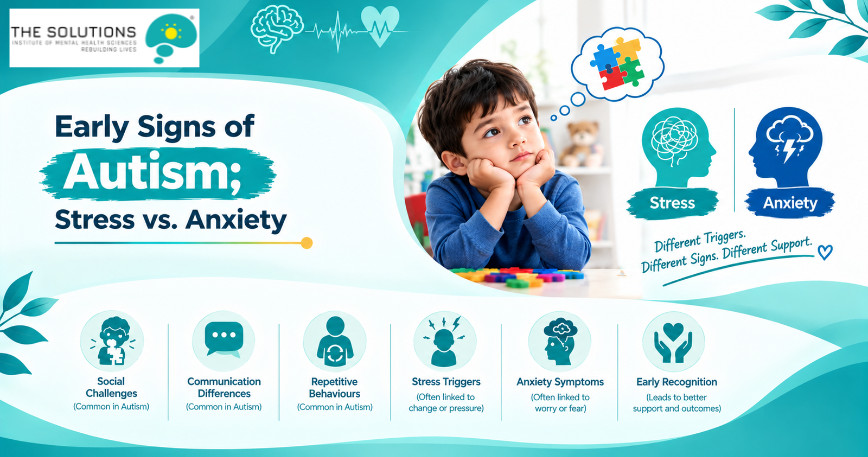
Almost everyone in a city like Hyderabad lives with some stress. Traffic, deadlines, school fees, ageing parents and long commutes all take a toll. So when people start feeling worn down, they naturally call it stress. Often they’re right. Sometimes, though, the feeling has quietly changed into something that doesn’t go away on its own. Understanding stress vs. anxiety helps you decide whether you need a weekend off or proper support.
Stress almost always comes from something you can name: an appraisal meeting, a loan payment, a child’s exams, a family member’s surgery. Your body prepares to deal with it. You feel tense, short-tempered, tired and a bit scattered. When the meeting is over or the results come out, the pressure lifts, and within a few days you feel more like yourself.
Anxiety doesn’t wait for a reason. It keeps going after the problem is solved, or it appears on a perfectly normal Sunday afternoon. Your thoughts move into the future and keep asking what could go wrong. Your body joins in with a racing heart, a churning stomach, shallow breathing, sweaty palms or nights where sleep just won’t come.
One of our counsellors explains it this way: stress is about what’s in front of you, and anxiety is about what might come next. If the worry keeps going long after the thing in front of you has gone, it’s worth looking at more closely.
Speak to a professional if the worry has lasted more than two or three weeks, if you’re avoiding places or people you used to be fine with, if you’ve had sudden panic attacks, or if your sleep, appetite or focus has clearly changed. Using alcohol or cigarettes to calm down is another sign that you need more support.
Some simple habits do help in the meantime. Breathe slowly, with a longer breath out than in. Take a short walk after dinner. Keep your phone out of the bedroom. Cut down on the third and fourth cup of tea. Talk to one person you trust. If you’ve tried these and still feel stuck, therapy such as Cognitive Behavioural Therapy (CBT) has helped a great many people. When you’re searching for the best hospital for stress-related disorders treatment, look for a team that takes time to listen and offers proven therapies like these.
We often see these two topics meet in one family. A mother brings her son in for an assessment, and halfway through the conversation she admits she hasn’t slept well in months. A father who seems calm on the outside is quietly worrying about his child’s future every night. That’s completely understandable. Caring for a child who needs extra support is demanding, and the stress builds up.
Autistic children and teenagers are also more likely to struggle with anxiety, especially around change, crowds or noisy places. So at IMHS, we don’t treat the child and forget the parent. Alongside your child’s therapy, you can get counselling and practical guidance for yourself.
Book Your Consultation in person or online, in a private, judgement-free space. Book your consultation today.
The early signs of autism usually appear between 12 and 24 months of age. IMHS offers early assessments, along with support for stress vs. anxiety in parents.
Not always. Late talking is one of the early signs of autism only when other signs come with it. IMHS can assess your child and help you manage stress vs. anxiety as you wait for answers.
In stress vs. anxiety, stress has a clear cause and fades with time, while anxiety lingers without one. Parents noticing the early signs of autism often experience both.
Seek help if you notice the early signs of autism in your child, or if stress vs. anxiety symptoms last more than two to three weeks.
IMHS offers autism assessments, child therapy and counselling for stress vs. anxiety, so families get support for the early signs of autism and their own wellbeing in one place.




WhatsApp us